|
Control Freak
By Ron Anlauf
Successful walleye anglers know that to
have any
 chance
of loading the boat they need to be in complete control of their
craft at all times. That means the ability to control speed and
direction, no matter what the conditions. If you can control
your boat you can control your bait allowing you to keep your
offering in the “zone” and maximize your opportunities. chance
of loading the boat they need to be in complete control of their
craft at all times. That means the ability to control speed and
direction, no matter what the conditions. If you can control
your boat you can control your bait allowing you to keep your
offering in the “zone” and maximize your opportunities.
Anything less can result in fewer or even
no fish caught, and that’s never any fun (in my opinion). While
there may be certain situations that are completely beyond your
reach, most of it can be dealt with.
Calm conditions are a piece of cake and
when anybody can stay in control, but it’s a different story
when things get rough. Even so with the right gear you can beat
a stiff wind and big waves and still come out on top.
Starting from the top down today’s
boat manufacturers have made big improvements in their hulls
that not only ride better and drier but are easier to control.
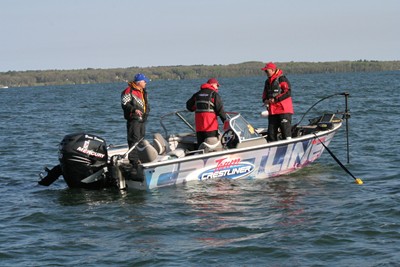
For example; my new Crestliner 1800 Super Hawk is designed to
sit level on the water and does so without a high riding bow
which would make it more prone to the wind grabbing it and
pushing it around. Improvements in electric trolling motors
have helped immensely with staying in control and have allowed
anglers to tame some of the roughest conditions.
Trying to stay on a tight break line in two
to three foot waves takes a lot of thrust and a little
coordination to get the job done. Today’s most powerful
trolling motors like Minn Kota’s Terrova and Vantage are
available in models up to an amazing 101lbs of thrust and can
help you stay where you want when you want to be there. If you
back it all up with high quality batteries like those built by
Optima with Spiralcell technology you can run all day and have
power to spare, and they really do make a difference. To give
you an example; I was having trouble losing power last year and
thought I wasn’t getting a full charge. What I found was the
problem wasn’t with the charging system. Instead it was the
fact that my riggers used another brand of battery and they
didn’t have the same high reserve capacity!
Speed is another important element and is
critical to successful trolling presentations. Finding and
duplicating productive speeds can be a rather frustrating
endeavor, especially if you’ve tried to accomplish the task with
standard equipment, like a depth finder with a speed indicator.
The depth finder indicatorsutilize a paddle wheel type sensor
and work well under calm conditions. However, they become
totally useless when you throw in a little wind. The problem
arises as the wind kicks up and you start to get surface
current. For example, a trolling run with the wind may be
indicated by a zero speed reading, even though you’re running up
to two mph or more. Today’s more accurate G.P.S. units like
Humminbird’s new 1197c can help and will display a speed reading
that you can actually use down to tenths of a mph.
Now that you know how fast you’re
running achieving an exact speed is the next problem. Trying to
get an outboard to run at a specific speed can be tough,
especially at slower speeds. My Optimax does an excellent job
down to about two mph and is about all I ever need. To get down
any slower you can drop a drift sock off the bow but it does
under steer a bit when trolling forward. Serious trollers may
opt for a kicker motor like Mercury’s 9.9hp ProKicker which is a
four stroke engine with power tilt that can run all day on
minimal amount of gas.
Drift socks like Minn Kotas MKA-27 are
also the answer to controlling a drifting presentation and it
wouldn’t hurt to have at least a couple in the boat. The MKA-27
drift sock has built-in floats and weights that help it to open
quickly and has a strap connected to that back of the sock that
will allow you to pull it out backwards and empty it before
pulling it in the boat. To hit the right speed you can
experiment with a single smaller sock for light wind conditions,
or maybe two larger bags for high winds and rough seas. A sock
with a larger bag should be used to handle the bow, while a
smaller bag can take care of the rear of the boat. The bow
will drift faster than the transom and the two bag setup will
help to keep you square. With socks out you can use an
electric trolling motor or even the main engine if you need to
move the boat forward or back.
An anchor may seem like a simple item
and is, but it can make all the difference when you want to take
control and camp out on a spot. There are different high tech
styles available but day in and day out it’s a plain old
twenty-eight pound navy anchor and a hundred and fifty feet of
rope that keeps me hooked up and on the fish. A twenty-eight
pounder is a lot to deal with when it’s time to pick it up but
when it’s dropped it will usually stay put, and that’s extremely
important.
When you lose control you lose confidence,
and confidence plays an important part in angler’s success.
By taking control you’ll soon find that there are plenty of fish
to be caught, even under the some of the toughest conditions.
Ron Anlauf |