There’s a great reason to look forward to the spring with ice
melting and rivers running. About 80 to 90 percent of the walleyes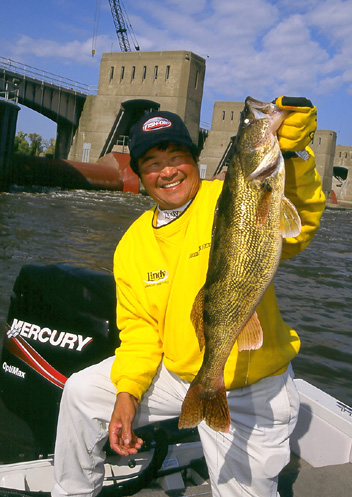 across the country move from main lakes into the rivers to spawn.
Unlike during the summer when trolling for big fish can be hit or
miss, big walleyes become more catchable when they migrate upstream
with the masses.
across the country move from main lakes into the rivers to spawn.
Unlike during the summer when trolling for big fish can be hit or
miss, big walleyes become more catchable when they migrate upstream
with the masses.
These fish can often be monsters, which is exciting. You’ve got
a better shot at the ten pounders as well as numbers of fish during
the spring pre-spawn run.
Rain and melting snow will fill rivers at various times and
produced strong current. Fast-moving water draws walleyes upstream
to spawning areas like a magnet.
River fishing can also be a blessing because valleys protect you
from the cold winds that may continue to blow hard in March and
April when the spawn takes place.
As good as all that sounds, high water and spring fishing present
their own problems. But, attention to detail and modifying
presentations to meet conditions can overcome the obstacles.
Locating fish
Finding walleyes during the spawning run isn’t always
easy. It may seem simple to look at a map and predict where
walleyes will spawn - on hard-bottom areas of gravel and sand as far
upstream as they can go until stopped by dams, rapids or other
obstacles, such as locks. In some places, walleyes over the
centuries have adapted to use other habitat, such as the marshes
found on the Lake Winnebago system.
After laying their eggs, females start back downstream while
males wait near spawning areas for late-arriving females. When
convinced the spawning run is over, males head downstream, too.
As a result, walleyes are constantly on the move in the river.
Anglers must be, too, if they want a chance to connect. Still,
you’ll often see boats hovering at the mouth off rivers where they
empty into main lakes or at other spots that produce for a while
long after the bulk of the fish have passed by.
You really have to be mobile when it comes to fishing spring fish
as they won’t hold in one area. That’s the problem. Many anglers
get too hung up on one spot.
Target spots where walleyes can escape fast-moving water anytime
you fish rivers, but especially in high water. Places like river
bends, holes, wing dams, bridges, even natural obstructions like
fallen trees will create eddies. These are areas where water moves
more slowly and walleyes can save their energy for spawning and
snatching food as it passes by. The higher the water, the sharper
the bend, the more fish the inside turn will hold.
Do not overlook the seams of slower water where current from
feeder creeks or where factory discharges meet the main flow of the
river. Water can be clearer there, which is an important detail when
high water can dirty the main river.
Run and gun until walleyes are located. Spring fishing can often
result in “pack fishing”, where several boats crowd onto the same
spot. But, walleyes will eventually respond to fishing pressure by
moving away or shutting down their activity. Don’t be afraid to go
your own way. Being a loner can pay big dividends.
Spring tactics
Anglers can often “over-think” their approach to fishing.
Big catches can be had by using a keep-it-simple philosophy while
paying attention to details that others overlook. In a river, a jig
and minnow combination can accomplish the task of catching multiple
fish while having a chance at the trophy we all like to brag about.
Vertical jigging while slipping with the current is an extremely
productive and enjoyable technique. Instead of waiting for fish to
come to you, you can go to them. You never know what’s in store for
you.
While most people might stick with monofilament, try using 10
pound test (2 pound dia.) Power Pro braided line. This switch to
braided line can transform your jig into an extra “eye” beneath the
water. Its sensitivity telegraphs the type of bottom content that
lies below, whether gravel, sand or mud. Its sensitivity also helps
detect light bites common in cold water, an edge that can be
critical when water is high. Power Pro’s thinner diameter cuts
through the water and permits use of lighter jigs.
With fast-moving current, it can be important to fine-tune your
presentation by adding a small number 12 barrel swivel in line to
prevent line twist. If you don’t use a swivel, you’re likely to
feel a “thump” and set the hook, only to miss the walleye. In that
case, it’s likely the jig was spinning and the hook was pointed away
at the crucial moment when the fish attacked the bait. A Lindy Max
Gap jig, with its custom, super sharp hook, can also help you catch
more fish.
From the barrel swivel, try adding a two-foot Gamma fluorocarbon
leader to the lightest jig that will reach the bottom and allow you
to stay vertical as the boat moves downstream with the current. If
your bait isn’t on the bottom, you aren’t in the walleye’s strike
zone. The angler in the back of the boat usually must step up a jig
size or stay as close to the front of the boat as possible to stay
on the bottom.
Color of your jig can always be a key factor. Think about how
many times you’ve been in a pack of boats and everyone seems to be
netting walleyes. Then, suddenly, the action stops. The fish quit
taking the chartreuse or orange jigs that everyone is using. Most
anglers will assume conditions changed and the bite is off. Or, the
fish moved away. These anglers will stick with the same jig, stay
in the same place and hope for the best. Make the assumption that
the active fish have been caught. More walleyes probably lurk
below, but they are the more inactive ones. Rather than trying to
trigger a feeding strike, try changing colors, change your jigging
motion, and go for a reaction bite. Even try something off of your
normal color chart.
It can be amazing that the simple things you can do that will
make a difference. You might only get one or two more, but by the
end of the day that can work out to a lot of fish.
Fishermen often have one mind set. If they aren’t catching fish
on chartreuse, they often believe that the fish aren’t biting. But,
change is big. Try using blue, pinks, purples… just something
different. Techni-Glo colors can be hot as well. Try adding a
plastic body like a Munchies Thumpin’ Grub tail.
In addition, try switching your live bait choice from the
standard minnow to half a nightcrawler. This typically happens a
little later in the spring when crawlers start getting flushed into
the river systems.
Anglers also overlook the importance of scent, a factor that can
be important when the water is cold. Jigs with hair, like
Fuzz-E-Grubs, hold scent longer than jigs without it. There are a
ton of commercial scent products to add to your jig.
Still not working? Fishermen also have the option of taking off
the jig, adding a clip and snapping on a blade bait, like a Heddon
Sonar. The vibration can help hungry fish locate it or trigger a
reaction bite from inactive fish. Rip it hard three times and
follow it down each time, then rip it half way and let it drop until
it’s just off the bottom, then hold it there.
Anchors away
High water can sometimes create boat control problems and
springtime cold fronts can sometimes turn action sour. Anchoring
can help.
Have you gone back to the spot where slipping with jigs was
producing for you the day before and you get stymied first thing in
the morning? Did they move overnight or are they still there and
just less interested than they were the day before? One way to find
out is to anchor upstream from the spot and cast or work a Wolf
River rig slowly on the bottom. Use a 3-way swivel with a short
dropper and a sinker heavy enough to stay on bottom, a 3-foot leader
to a simple hook, orange bead and a minnow. This can be a deadly
technique during cold fronts on the river.
Instead of a 3-way, you can also use a jig as well, but use
enough weight so the jig returns to the same exact spot every time
you pump, pump, pump it so fast you wonder how a fish could hit it.
The goal is to entice reaction bites. Follow the jig back down each
time you snap it. Use two rods, where legal. Put your 3-way rig on
the bottom and put the rod in a rod holder. Jig the other one.
The same tactic works if walleyes simply moved closer to the bank
on sharp turns to escape strong current. Some fish will go right
into the trees, so position your boat right next to them and anchor.
After the walleyes have spawned, food becomes more important as they
begin moving back downstream to the main lake. As a result,
walleyes can be caught first thing in the morning by trolling
crankbaits on shallow flats. Don’t waste time. If they are there,
you’ll catch them right away.
Capitalize on the action as long as it lasts. Boat traffic and
sunlight will push them deeper soon.
Got cabin fever? Spring walleye fishing is the cure.